Reflections the Bioeconomy Finance Hub and COP 30’s Strategic Pivot
South Africa’s historic G20 presidency was more than a diplomatic milestone. It reframed the global conversation on prosperity and resilience amid escalating climate and nature risks. At the heart of this shift lies the Africa Bioeconomy Finance Hub, co-created by the African Natural Capital Alliance (ANCA), FSD Africa, and NatureFinance with input from the G20 Initiative on Bioeconomy. This Hub is not theoretical, it is a practical engine to channel capital, policy, and innovation toward nature-positive growth.
From Tshwane to Belém, the momentum has been unmistakable, and the timing could not have been more critical. At COP30 in Brazil, the Bioeconomy Challenge elevated bioeconomy to the center of the global climate agenda for the first time in COP history. The convergence of Africa’s leadership and Brazil’s initiative underscores a powerful truth: the bioeconomy is no niche, it is a lifeboat for a planet in crisis and a blueprint for inclusive prosperity.
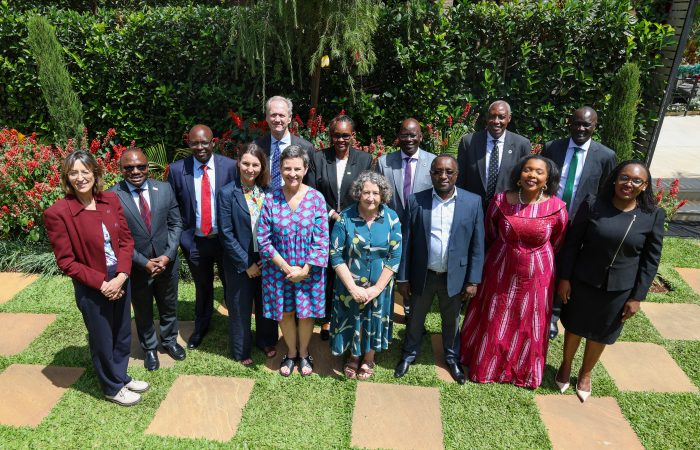
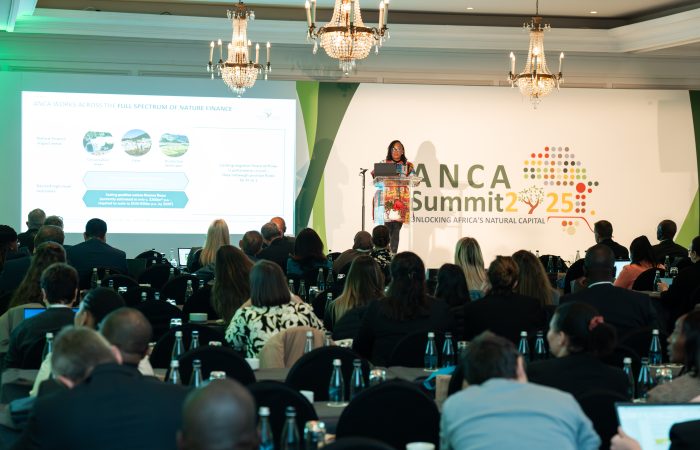
The GIB Tshwane meeting in September marked the culmination of South Africa’s G20 presidency, the first ever for an African nation, and the formal launch of the Africa Bioeconomy Finance Hub, a legacy initiative designed to endure beyond this presidency. Paired with Brazil’s COP30 announcement, these milestones signal a maturing global consensus: the bioeconomy is a strategic pathway for decarbonization, biodiversity conservation, and inclusive growth.
Beyond Climate Mitigation: Bioeconomy as Resilience Strategy
According to Julie McCarthy, CEO of NatureFinance, the bioeconomy is not merely an environmental imperative. It is a critical resilience strategy. Some sectors and communities will not adapt fast enough to escalating climate volatility unless we fundamentally diversify what we produce and how we produce it. This reality demands what McCarthy calls “lifeboat strategies”, targeted, time-bound interventions that protect livelihoods and food security while accelerating innovation in vulnerable sectors. Consider alternative proteins such as insect-based production systems. They require fewer inputs, occupy smaller land footprints, and generate lower emissions, making them ideal for drought-prone regions and stressed supply chains. These lifeboats don’t replace long-term transitions; rather, they buy critical time, reduce systemic risk, and seed value chains that are inherently compatible with planetary boundaries.
McCarthy also identified subsidy reform as the fulcrum of transformation. Today’s regimes too often reward extraction and high emissions, creating structural headwinds for regenerative producers. Redirecting subsidies—or even just introducing new subsidies for regenerative agriculture, bio-based innovation, and biodiversity-enhancing enterprises would fundamentally incentivize capital flows towards future-proofing key sectors.
This recalibration of financial incentives is how we normalize nature-positive finance, not through voluntary commitments alone, but by changing the underlying rules of economic engagement. When governments align subsidies with regenerative outcomes, they catalyse systemic shifts in capital allocation at scale. As Flora Mokgohloa, Deputy Director-General for Biodiversity and Conservation at South Africa’s Department of Forestry, Fisheries and the Environment, emphasized: “Government’s job is to make the enabling environment real. When regulation, standards, and institutional support line up, capital moves, innovation scales, and communities benefit.”
Why the Bioeconomy Matters Now: A Turning Point, & A Shared Agenda
What changed between Johannesburg and Belém? Three developments converged to transform the bioeconomy from aspiration to strategic imperative. First, policy clarity. Under Brazil’s 2024 G20 presidency, members agreed on Ten High‑Level Principles on the Bioeconomy, the first multilaterally agreed framework devoted specifically to this agenda. Those principles commit countries to advance inclusion and equity (with attention to Indigenous Peoples and Local Communities), to conserve biodiversity, and to promote circular, bio‑based production. South Africa’s presidency mainstreamed these principles across a Global South‑led cycle and carried them into implementation dialogues..
Second, formal status in the climate arena. Brazil’s COP30 presidency launched the Bioeconomy Challenge and placed bioeconomy under Goal 29 of the COP Action Agenda (“Bioeconomy and Biotechnology”), with defined workstreams on metrics (FAO), finance (IDB and partners), market development and trade (UNCTAD), and socio-bioeconomy and community benefits (WRI). NatureFinance serves as Executive Secretariat under a shared governance model.
Third, a credible market case. Independent analyses now value today’s bioeconomy at $4–5 trillion, with growth potential to $30 trillion by 2050, driven by regulation, consumer preference shifts, and the need to substitute fossil inputs with bio-based materials and processes.
Daniel Boeira Lodetti, Deputy Head for Sustainable Development at Ministry of Foreign Affairs of Brazil emphasised that “the bioeconomy represents an inevitable economic transition; the substantive challenge now concerns the velocity and coordination with which the global community can operationalise this transformation.”
The Fundamental Economic Realignment: Reconciling Sustainability and Prosperity
The reason for urgency is straightforward. In a world of physical limits, economies that value resilience outperform. Countries able to restore degraded soils and watersheds, industrialise bio-processing close to feedstocks, and share value fairly with communities will be more competitive on productivity, export diversification, and risk ratings. The G20 Principles and COP30 Challenge place inclusion, biodiversity conservation, and circular production at the center of this equation.
The bioeconomy is not a niche sector. It is an operating system upgrade for economies confronting climate instability, biodiversity loss, and inequality. The World Economic Forum frames this as five interlocking dimensions; forests, agriculture, sociobioeconomy, biotechnology, and finance, a practical map for both investors and policymakers.
Khorommbi Matibe, Chief Director, Biodiversity Economy & Sustainable Use at the Department of Forestry, Fisheries and the Environment articulated the paradigm shift required “The bioeconomy framework necessitates a fundamental inversion of prevailing economic narratives, constructing economic models wherein sustainability and equity command valuation equivalent to wealth accumulation in contemporary systems.” This proposition resonated throughout the gathering and discussions. The bioeconomy represents not merely an environmental imperative but rather the most consequential economic opportunity of the present era.
On the continent, the case is particularly urgent. Africa currently captures less than 10% of the economic value from its biomass, even as soil degradation drains roughly USD 195 billion annually. That is not a rounding error, it is a structural failure that suppresses incomes, weakens food security, and accelerates ecological decline.
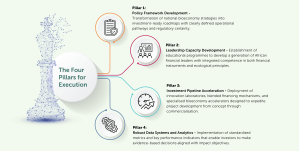
Theresa Reisch, Senior NatureFinance Advisor, FSD Africa presented empirical data that underscored the urgency of coordinated action. She offered an apt analogy: “Capital allocation functions analogously to water—it inevitably follows pathways of least resistance.” The Bioeconomy Finance Hub has been specifically designed to eliminate these structural barriers to investment that keep capital from flowing toward regenerative opportunities through a four-pillar strategic architecture.
Dorothy Maseke, Head of ANCA’s Secretariat, articulated the Hub’s transformative potential: “This initiative has the capacity to fundamentally reorient Africa’s economic trajectory, catalysing the mobilisation of USD 50 billion in investments by 2035 whilst ensuring that African markets, knowledge systems, and communities occupy central positions within global solutions.”
The Four Pillars for Execution
Beyond Mitigation: Constructing Regenerative Economic Systems
A consensus emerged throughout the proceedings that regeneration—actively designing economies that restore and enhance natural systems—must supersede the more limited objective of mitigation. As one participant articulated: “The imperative extends beyond preventing harm; we must construct economic systems intentionally calibrated to regenerate and restore ecological integrity.”
Dr. Sue Snyman from Africa Leadership University presented a comprehensive analysis of priority sectors across Southern African Development Community (SADC) countries, demonstrating the regional diversity of bioeconomy applications, from agroforestry in Zambia to marine bioeconomy in Mozambique. Ms Marta Gomez San Juan from the Food and Agriculture Organization also shared findings from their database of over 4,000 indicators, providing empirical evidence that biodiversity constitutes a primary driver of systemic transformation rather than an ancillary consideration.
Yet the path to regenerative systems faces a fundamental obstacle. As Julie McCarthy, CEO of NatureFinance, put it: “We can’t ask the future to outcompete the past while the past is still being paid to stay.” This captures the central challenge around which the collective commitment resonated clearly: contemporary economic design must transcend incremental sustainability improvements and instead deliberately construct systems capable of ecological and social regeneration. Achieving this requires dismantling the subsidies and incentives that keep extractive models artificially competitive.
Strategic Objectives and Measurable Impact Targets
The Bioeconomy Finance Hub has established ambitious yet achievable targets for 2035 that seek to translate this regenerative vision into concrete action:
- Agricultural Stakeholder Engagement: Extending bioeconomy innovations and technical support to approximately 10 million farmers across African contexts
- Capital Mobilisation: Catalysing investment flows exceeding USD 50 billion across African lower and middle-income countries
- Circular Economy Implementation: Achieving a 30 per cent reduction in agricultural waste through systematic adoption of circular economic models
- Value Capture Enhancement: Increasing Africa’s capture of biomass-derived economic value from current levels below 10 per cent to 50 per cent
These targets reflect rigorous strategic planning rather than aspirational thinking. Given global bioeconomy projections indicating a market valuation of USD 30 trillion by 2050, Africa’s strategic positioning to lead rather than follow this transformation represents a critical opportunity for continental development.
Institutional Implementation Pathway
The implementation phase of the Hub commenced in the fourth quarter of 2025 and will translate ambition into action. The Bioeconomy Finance Hub is currently working to define two to four strategic focus areas such as regenerative agriculture and Indigenous knowledge-based economies, supported by co-created implementation roadmaps. These roadmaps will be developed through structured stakeholder roundtables, ensuring that diverse voices shape practical pathways for nature-positive growth.
Other complementary initiatives are already accelerating. The Council for Scientific & Industrial Research (CSIR) announced its Regional Technical Support Hub initiative, designed to facilitate commercialisation of bioinnovations among 18–22 African small enterprises. This programme specifically addresses what CSIR characterises as the “valley of death”, the persistent development gap between laboratory innovation and market-ready application, a critical constraint on bioeconomy scale-up.
Continuity and Global Momentum: COP30 and the Bioeconomy Challenge
The deliberations in Tshwane must be contextualised within concurrent global bioeconomy developments. Brazil’s November 2025 announcement at COP30 of the Bioeconomy Challenge—described as the first occasion in COP history wherein bioeconomy has been positioned as a central strategic objective—represents a critical continuation and acceleration of momentum initiated under South Africa’s G20 presidency. The Bioeconomy Challenge has been explicitly structured to operationalise the ten G20 High-Level Principles across five priority areas: forests, regenerative agriculture and restoration, sociobioeconomy, financing innovation, and bioindustrialisation.
This global coordination challenge—articulated by Brazil as the essential prerequisite for scaled bioeconomy implementation—directly builds upon foundations established during South Africa’s engagement, demonstrating the continuity between these complementary initiatives.
An Enduring African Legacy
The Tshwane meeting concluded with affirmation of a shared vision for sustainable, equitable, and globally responsible development. As one participant reflected: “With demographic projections indicating that one in four global inhabitants will be African by 2050, the bioeconomy represents a potential catalyst for unprecedented prosperity—a narrative of regeneration, innovation, and coordinated ambition that the international community increasingly recognises as essential.”
The Bioeconomy Finance Hub is Africa’s declaration that future economic systems must be fundamentally reconstructed to place nature, innovation, and collective ecological stewardship at their foundation. However, it is essential to recognise that the Hub represents only one of several consequential legacy initiatives established during this transformative African G20 presidency.
Additional initiatives advancing from South Africa’s tenure include the G20 Initiative on Bioeconomy’s High-Level Principles framework—which continues to guide global bioeconomy policy architecture—and complementary initiatives on climate-resilient agriculture and nature-positive finance mechanisms that collectively represent an integrated approach to sustainable development.
These initiatives collectively constitute South Africa’s enduring contribution to global development architecture, establishing frameworks and mechanisms that will facilitate continental and international progress on climate resilience, biodiversity conservation, and inclusive prosperity for generations to come.
The bioeconomy is Africa’s moment. From Tshwane to Belém, the infrastructure is being built, the partnerships are forming, and the capital is beginning to flow. What’s needed now is the collective will to move from strategy to implementation, from principles to practice, from potential to prosperity.